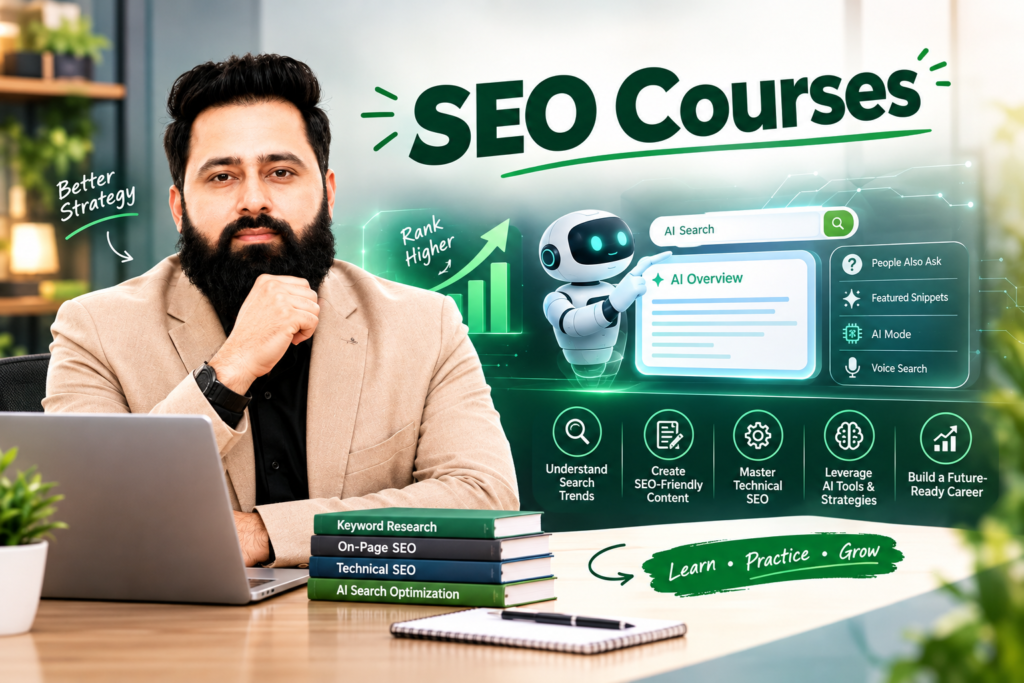
An SEO Course offers knowledge on optimizing sites for conventional search engines and AI searches like Google AI Overviews. Nowadays, the world of SEO is much broader than just using keywords. Instead, it requires dealing with search intent, content quality, technical site parameters, and information structuring, and it also helps in knowing how search engines function.
AI opens up new opportunities for information search and learning SEO means understanding how to provide search engines with information that can be interpreted well. A proper SEO course teaches how to achieve this through practical exercises on site optimization, searching for the right keywords and technical SEO.

Why Is SEO Changing With the Growth of AI Search?
The advancements in search engines aim for users to get more than just a list of websites. At the moment, we see Google AI Overviews, AI-based search and other generative search designs change the way users deal with online content.
However, this does not mean that SEO is on its way out. It is crucial for website owners to understand how people find, comprehend and assess content.
Many things have changed in today’s SEO.
- Search intent: It is important to know what the user is really looking for instead of focusing on keywords.
- Valuable content: Providing the user with credible, accurate and relevant information.
- Content design: Presenting the information logically with the help of relevant headings and sections followed by answers.
- Technical optimisation: Making sure that websites are crawled, indexed and have all technical issues taken care of.
- Authority: Establishing trustworthiness and knowledge through the content of the website.
By learning all of these changes throughout an SEO Course, students begin to understand why they cannot skip the old SEO methods and need a new approach to it.
How Does an SEO Course Teach Website Optimisation for AI Search?
A well-structured SEO course introduces learners to the essential optimisation techniques that help search engines understand website content. It also helps them explore how content can be organised to address conversational queries and AI-driven search experiences.
Here are the essential areas learners should understand:
1. Search Intent and Conversational Keyword Research
Keyword research does not only involve identifying the search volume and the difficulty of a keyword. An SEO expert should understand the reason of the user behind making the specific query and the expected answer.
For example, instead of focusing on the keyword “SEO Course,” a website can combine the other related queries, such as:
- How to learn SEO for beginners?
- What SEO skills to acquire to rank the website?
- What is the role of SEO in generating organic traffic?
- How to be listed in AI search results?
An SEO course teaches students to identify related queries, study SERP results, understand user intent, and create content that satisfies the needs of users.
2. Creating Content That Answers User Questions
Keyword research does not only involve identifying the search volume and the difficulty of a keyword. An SEO expert should understand the reason of the user behind making the specific query and the expected answer.
For example, instead of focusing on the keyword “SEO Course,” a website can combine the other related queries, such as:
- How to learn SEO for beginners?
- What SEO skills to acquire to rank the website?
- What is the role of SEO in generating organic traffic?
- How to be listed in AI search results?
An SEO course teaches students to identify related queries, study SERP results, understand user intent, and create content that satisfies the needs of users.
3. Technical SEO and Website Accessibility
Technical SEO is an essential component to make even best quality content visible on the Internet.
SEO courses should offer training related to the following topics:
- Crawling and indexation
- XML and robots.txt
- Canonical tags
- Page speed and Core Web Vital
- Mobile compatibility
- Internal linking
- Structured data and schema.
These skills enable students to diagnose technical issues that can hurt website visibility, which also gives them necessary information to communicate with developers whenever web development changes are needed.
4. Understanding Structured Data and Content Context
Structured data is an important factor in allowing search engines to recognize important facts about web pages and their content. Schema markup can convey information regarding structures, products, organizations, articles, events and other types of content that are supported by it.
Students need to understand how to correctly use relevant schema markup, test it and confirm that it reflects the visible content on the web page.
Nevertheless, structured data is not a guarantee of rankings, inclusion in AI Overview or obtaining rich results by itself.
What SEO Skills Are Useful for AI-Powered Search Visibility?
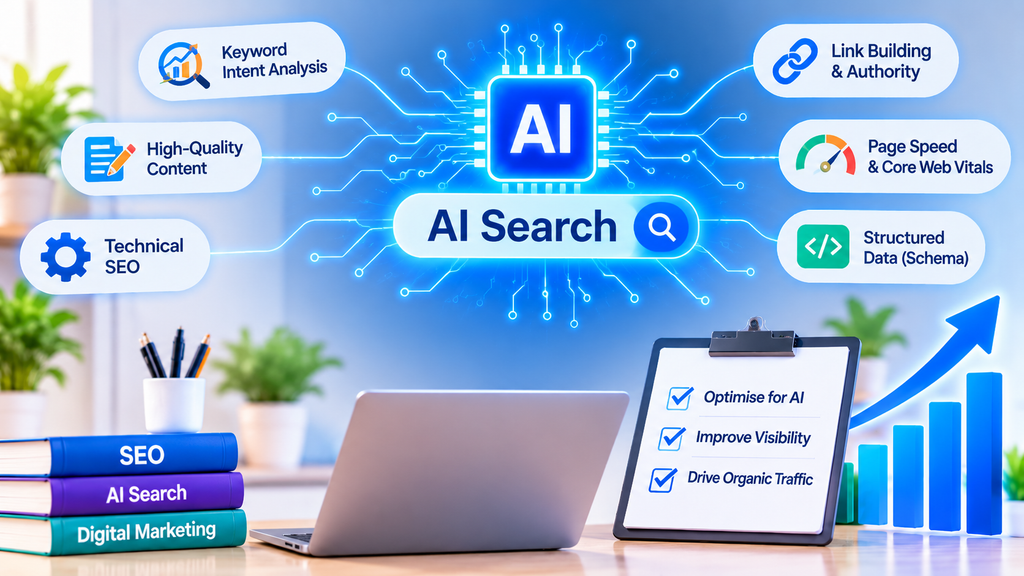
Modern SEO professionals need a combination of analytical, technical and content-related skills. An SEO Course can help learners develop these capabilities through structured learning and practical website work.
| SEO Skill | How It Helps |
| Keyword research | Identifies relevant queries and search intent. |
| On-page SEO | Improves page relevance, headings, content and internal links. |
| Technical SEO | Helps search engines access and understand website pages. |
| Content optimisation | Creates helpful, structured and relevant content. |
| Schema markup | Communicates supported structured information about pages. |
| SEO analytics | Measures impressions, clicks, traffic and performance. |
| AI search optimisation | Helps develop content strategies for evolving search experiences. |
These skills are relevant for website owners, freelancers, digital marketers and aspiring SEO professionals who want to work with modern search optimisation.
How Can You Practically Optimise a Website for AI Search?
Whilst it is good to be able to understand SEO, it is even better to practise these methods and apply them to a site so that you can observe their impact. Following are steps which can be used to practically utilise SEO:
1. Research your audience – investigate what your audience search for, together with any issues that they have and the type of information they require.
2. Investigate current search results – study other sites which answer the search, along with the content and the searcher’s intent. Furthermore, analyse which information Google is most likely to display for that search term.
3. Design content. Divide content into appropriate sub-topics. Ensure that key issues are addressed and that superfluous information is not included.
4. Optimize the site. Assess how the site is indexed. Further, analyse navigation, loading times, responsive design and schema markup (where appropriate).
5. Enhance the content. Include pertinent and high quality examples, information and analysis in order to display knowledge and expertise.
6. Evaluate search statistics. Utilise both Google Search Console and analytic resources to assess data including impressions, clicks, search terms and indexing, as well as site statistics. Analyse this information and then further develop the site in response to the findings.
In this way, individuals can effectively relate theoretical knowledge of SEO to the practice of optimising a site.
How Can You Choose the Right SEO Course for AI Search?
It is important to ensure the appropriate course is selected. As an ever developing area of study, people should check that a course addresses core and modern topics within SEO and also provides hands-on training for website SEO.
Look out for courses which include:
- Technical SEO, content, keyword, link and AI SEO – both core and more modern areas.
- Hands-on experience with website analysis, keyword and content analysis and then report writing.
- Training for SEO software including Google Search Console, Google Analytics, keyword and technical SEO software.
- Application to industry – scenarios which show how SEO can be used within company websites.
- Advice and coaching so that students can recognise and rectify errors and further refine their SEO methods.
- These points can therefore enable people seeking an SEO course in Noida to analyse different institutes and decide upon one which best provides good hands-on training.
Furthermore, students can undertake a certification course for SEO. Although this can offer good organisation for a person’s learning and also evidence that a course has been completed, the quality of the certification will rely on the content, application and skills gained.

Can SEO Be Learned Alongside Social Media Marketing and Digital Marketing?
SEO is a key element of digital marketing, but it doesn’t work in isolation. It’s one of a number of channels that will help you build awareness, reach your audience and generate leads.
A social media marketing course will teach you about audience engagement, social content, campaign planning and platform specific strategies. It’s a very useful course in conjunction with your SEO as it enables you to use social media to distribute your content, build your brand and engage with your audience.
A more comprehensive digital marketing course would cover SEO, social media marketing, paid advertising, content marketing, email marketing, analytics and conversion optimisation.
Understanding these disciplines in conjunction with each other can go a long way to helping the learner to build a more holistic digital marketing strategy. That said, SEO in itself is a very specialist discipline requiring a specific understanding of search engines, technical site optimisation, organic search behaviour and search performance analysis.
Conclusion
DigiDir Academy helps learners gain knowledge and develop practical SEO skills to optimise websites for an evolving search landscape, including AI-powered search. This involves understanding search intent, creating valuable content, implementing technical SEO strategies, and analysing website performance.
Alongside core SEO knowledge, learning emerging AI search techniques can help learners prepare for opportunities in digital marketing, freelancing, and website management. The focus remains on understanding how search engines work, meeting user needs, and creating helpful, relevant, and valuable content.
Frequently Asked Questions (FAQs)
1. Can an SEO course teach you how to rank in Google AI Overviews?
An SEO course can teach you content optimisation, technical SEO, search intent analysis and content structuring techniques that support search visibility. However, no course or optimisation technique can guarantee placement in Google AI Overviews.
2. What should an SEO course cover for AI search optimisation?
It should cover keyword research, technical SEO, content optimisation, structured data, search intent, content quality, analytics and an understanding of evolving AI-powered search experiences.
3. Is SEO still worth learning with the growth of AI search?
Yes. SEO remains relevant because search engines continue to discover, evaluate and present online content. AI is changing search experiences, but website accessibility, relevance, quality and technical optimisation remain important.
4. Can beginners learn SEO without technical knowledge?
Yes. Beginners can start with keyword research, on-page optimisation and content basics before progressing to technical SEO, analytics, structured data and more advanced optimisation techniques.
5. How does an SEO course help in a digital marketing career?
An SEO course can help learners develop practical skills in website optimisation, keyword research, content strategy, technical audits and performance analysis, which are useful for SEO roles, digital marketing positions, freelancing and managing business websites.